The intact soul of the Parisian bistro.
Since 1941, Café Max has been a living part of the Invalides neighbourhood. A traditional bistro, a Resistance refuge, the table of chef Frédéric Vardon. Each era has left its mark without erasing those before.

« A story we don't shout, but one the walls have never forgotten . »

Since 1941
Café Max opened its doors in 1941, at 7 avenue de la Motte-Picquet, steps from Les Invalides. From the start, the bistro became part of neighbourhood life — a place of passage, conversation and Parisian conviviality.
During the Occupation, Café Max became a discreet meeting point for members of the Resistance. The very name echoes 'Max', the alias of Jean Moulin. A history whispered rather than proclaimed, but one the walls have never forgotten.
Since then, the bistro has endured without ever losing its identity. It has seen generations of regulars, travellers and bistro lovers pass through — always the same bar, the same warmth, the same spirit.
1941, in occupied Paris.
On 14 June 1940, the Wehrmacht entered Paris. Over the four years that followed, the capital lived under German rule. The 7th arrondissement, more than any other, changed face: its public buildings requisitioned one by one, its avenues hung with swastika flags, the ceremonies of occupation following one another on the esplanade des Invalides.
At 7 avenue de la Motte-Picquet, 200 metres from the Dôme, Café Max opened its doors in 1941. In a city where rationing had become daily routine, where the black market was taking shape, and where soon two million bicycles served three million inhabitants, opening a bistro was at once an instinct of economic survival and the stubborn gesture of a civil life refusing to be erased.
The street was crossed morning and evening by the boots of German officers on their way to headquarters. The bistro, for its part, poured drinks for the Parisians who remained: French civil servants from neighbouring ministries, locals from the district, administrative staff. Conversation was measured, sometimes coded, always wary of unwelcome ears.
Why ‘Max’?
Jean Moulin’s codename.
Jean Moulin (1899-1943) is one of the major heroes of the French Resistance. As prefect of Eure-et-Loir before the war, he refused to authenticate false accusations against Senegalese soldiers in June 1940 and attempted suicide rather than yield. Dismissed by Vichy, he reached London in 1941, where General de Gaulle entrusted him with the mission that would mark History: unifying the scattered movements of the internal Resistance.
For this clandestine mission, Jean Moulin took on around ten pseudonyms across networks and periods: Régis, Rex, Joseph Jean Mercier, Jacques Martel, Romanin, Joseph Marchand, Richelieu, Alix and, finally, ‘Max’. That last codename was used during his final missions, in the closing phase of unification.
On 27 May 1943, Jean Moulin chaired the first plenary meeting of the Conseil National de la Résistance in Paris, at 48 rue du Four (6th arrondissement), 1.5 km from Café Max. Eight Resistance movements, six political parties and two trade unions sat together for the first time. That founding act sealed the legitimacy of Free France against American and British pressure.
Three weeks later, on 21 June 1943, Jean Moulin was arrested at Caluire-et-Cuire, near Lyon. Tortured by Klaus Barbie, he died on 8 July 1943 in the convoy that was to deport him to Germany. His body has never been identified with certainty.
On 19 December 1964, his presumed ashes were transferred to the Panthéon, in a ceremony presided over by General de Gaulle. André Malraux delivered there one of the most famous speeches in the Republic’s history: ‘With your terrible cortege, enter here, Jean Moulin...’.
To give a bistro in the 7th arrondissement the name of a shadow hero’s alias is to stretch a thread between a table and a memory. It is to say, in a low voice, that the walls do not forget.
Further reading
- Daniel Cordier, Jean Moulin, l’inconnu du Panthéon, J.-Cl. Lattès, 1989 (the reference biography by his former secretary).
- Jean Moulin on Wikipedia: timeline, sources and detailed bibliographical references.
- Musée de l’Ordre de la Libération, 129 rue de Grenelle, 75007 Paris: a 5-minute walk from Café Max, inside the grounds of the Hôtel National des Invalides.
The 7th arrondissement,
German theatre of the Occupation.
While Paris lived four years under occupation, the 7th arrondissement lived those years on the front line of administration. It was here, in this district of ministries and republican palaces, that the Germans installed the bulk of their governing apparatus.
Within a 5-minute walk of Café Max, in a radius of barely a few streets, one would find:
- The Hôtel National des Invalides: requisitioned for Wehrmacht headquarters services.
- The German Embassy, 78 rue de Lille: seat of Otto Abetz, Reich ambassador in Paris.
- The Palais Bourbon (quai d’Orsay): seat of the German military administration of Gross Paris.
- The Palais du Luxembourg (on the border with the 6th): Luftwaffe headquarters for the West.
- 12 rue de Varenne: the German military tribunal where captured Resistance members were tried.
This unique density made the 7th a daily stage of occupying domination. Field-grey uniforms crossed paths at every street corner. For a bistro opening in 1941 in this atmosphere, every service, every bill, every conversation at the counter was a scene where two worlds met: the silent Parisians and the passing occupiers.
The bistros and cafés of the district stayed open throughout the Occupation. Many operated as discreet relays: transit points for messages, reunion places for members of a single network, or simply attentive observation posts. The memory of these places remains, for the most part, oral. Unwritten by nature, undocumented by necessity.
Sources: ‘Paris in World War II’ (Wikipedia) · Henri Noguères, Histoire de la Résistance en France, Robert Laffont, 1967-1981.
From 1944 to today,
85 years at the counter.
On 25 August 1944, General Leclerc’s 2nd Armoured Division entered Paris. The Hôtel des Invalides was liberated. On the esplanade, marked for years by German parades, the tricolour flew once again. The neighbourhood drew breath.
Café Max, for its part, kept its doors open. The Trente Glorieuses turned it into a daily fixture: coffee taken at the counter, comments on the first Citroën DS cars climbing the avenue, debates on the nascent Fifth Republic, celebration of the 1998 World Cup victory.
Over the decades, the bistro saw generations of regulars pass through: civil servants from the neighbouring ministries, Sciences Po students, travellers come to visit Napoleon’s tomb, tourists wandering between the Eiffel Tower and the Champ de Mars. The setting barely changed: the period zinc counter, the red banquettes, the patinated parquet. The cuisine evolves, eras follow one another, but the identity holds.
Today the bistro has been taken over by Chef Frédéric Vardon, trained in great houses and faithful to traditional bistro cooking in the Parisian style. More than 400 wine references in the cellar, a menu that changes with the seasons, and a Chef’s slate that turns over each month. A permanent terrace on avenue de la Motte-Picquet, supplemented each year by a seasonal terrace from April to October.
Café Max is not a museum. It is a living bistro, still writing its history one service at a time. Memory is not displayed on the walls. It is in the zinc, in the light that falls on the terrace at six in the evening, in the way regulars and passing visitors alike are welcomed.
Germain Eugène’s flag,
at Les Invalides, August 1944.
Before it became Chez Max and then Café Max, the bistro at 7 avenue de la Motte-Picquet went by another name: L’Élice. Its owner during the Occupation years was Germain Eugène. The café was one of those places the war did not shut down, open every morning despite rationing, despite the field-grey uniforms taking their seats every day, despite the conversations that had to be held in a low voice.
On 25 August 1944, General Leclerc’s 2nd Armoured Division entered Paris. Les Invalides was liberated within hours. That same day, while sporadic fighting still raged in other districts, Germain Eugène carried out the act that would remain in the memory of the house.
He took from behind the bar a tricolour flag he had carefully hidden since the start of the war. He slipped it under his arm, crossed the avenue, walked to the esplanade des Invalides. He climbed the flagpole where the German flag still flew, took it down and replaced it with the French flag, in full view of the German soldiers who had been customers at his café every day for four years. Dumbfounded, they did not react.
The act remained discreet, like most acts of ordinary Resistance: no official witness, no photograph. It was passed on by word of mouth, in the family and then among the café’s regulars. It took until 2026 for a contemporary witness to share it in writing, finally giving a name to the man who raised the flag of liberation over Les Invalides that morning.
« During the liberation of Paris by the Leclerc Division and the Resistance, Monsieur Germain Eugène, then owner of the café-restaurant L’Élice, today Chez Max, took a tricolour flag he had carefully hidden, slipped it under his arm and walked to Les Invalides, then climbed the flagpole where the German flag was flying, took it down and replaced it with the French flag, in full view of the German soldiers who had been customers at his café every day. Dumbfounded, they did not react. What an act of heroism. »
André Duvergé, contemporary of several Resistance members in the 7th arrondissement, recorded in June 2026.
Walk the neighbourhood
in the footsteps of the Resistance.
For those who wish to extend the experience beyond lunch, a few steps are enough to step into the memory of the Parisian Resistance. Here is a suggested route starting from Café Max:
- 1. Café Max (starting point): lunch or an aperitif before the walk.
- 2. Le Dôme des Invalides (5 min walk): Napoleon’s tomb, and also a key site of the Liberation of Paris in August 1944.
- 3. Musée de l’Ordre de la Libération, 129 rue de Grenelle (entrance Place Vauban, 5-7 min walk from Café Max). The official account of Free France, the personal archives of Jean Moulin and of the 1,038 Compagnons de la Libération named by General de Gaulle. Free admission for visitors under 26.
- 4. Musée de l’Armée, also at Les Invalides, for a wider view of the Second World War in all its dimensions.
- 5. (Optional) Mémorial du Maréchal Leclerc and Musée Jean Moulin, 23 allée de la 2e D.B., Jardin Atlantique (Montparnasse). 15 minutes by metro (line 8 → line 6, or direct). CNR memorial, Moulin archives, permanent exhibition.
Did you know?
The Musée de l’Ordre de la Libération, set within the grounds of the Hôtel des Invalides, is the official institution that keeps the memory of the Compagnons de la Libération. Jean Moulin features among the most illustrious. A 5-minute walk from Café Max.
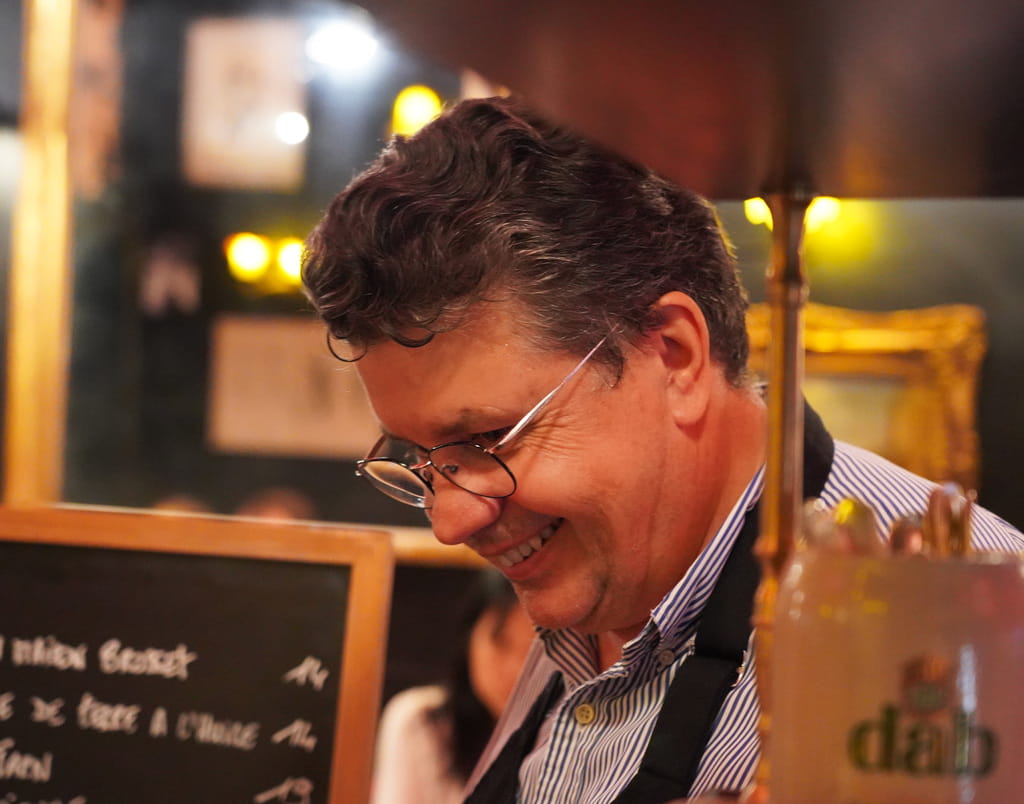
Frédéric Vardon at the helm.
Chef Frédéric Vardon took over Café Max with one conviction: to keep the Parisian bistro alive in its most generous form. Trained in prestigious kitchens, he chose to return to essentials — produce, seasons, the right gesture.
His cooking is honest, precise, free of trends. Dishes with character, a wine list conceived as a collector's cellar, and a welcome that makes you want to return.
Cooking is above all a story of encounters: with a product, a winemaker, a regular who comes back.
Warm and Convivial.
White tablecloths, red banquettes, a vintage zinc counter and a wide sunlit terrace on Avenue de la Motte-Picquet from April to October. Café Max is the spirit of the Parisian bistro in its most authentic setting — a place where you feel at home the moment you walk in.


The press on Café Max.
‘Historic Resistance bistro in Paris 7th.’
Le Figaro · Laurence Haloche
‘A historic landmark of the Resistance in Paris 7th.’
Sortir à Paris
‘Two Parisian bistros steeped in history and Resistance.’
Slate
Everything you
wanted to know.
Why is it called Café Max?
Café Max takes its name from Jean Moulin, hero of the French Resistance, who used 'Max' among his clandestine pseudonyms between 1942 and 1943. Founded in 1941 in the 7th arrondissement of Paris, in the midst of the Occupation, the bistro carries the memory of that commitment. The name is a tribute to a man who, behind dozens of borrowed identities (Régis, Rex, Max, Joseph Mercier), unified the movements of the Resistance before his arrest at Caluire in June 1943.
When was Café Max founded?
Café Max was founded in 1941, at 7 avenue de la Motte-Picquet (Paris 7th), during the Second World War. At that point, Paris had been occupied by the German army since June 1940. The 7th arrondissement, which housed most of the Wehrmacht's headquarters services (Hôtel des Invalides), the German Embassy (78 rue de Lille) and the administration of 'Gross Paris' (Palais Bourbon), lived under a constant military presence. Opening a bistro in this context was at once a matter of economic necessity and an act of civil continuity.
Does Café Max have a connection with Jean Moulin?
Yes, through its name. Café Max pays tribute to Jean Moulin (1899-1943), prefect of the Republic and hero of the Resistance, who used 'Max' as one of his codenames. Jean Moulin chaired the first plenary meeting of the Conseil National de la Résistance (CNR) in Paris on 27 May 1943, at 48 rue du Four (6th), about 1.5 km from Café Max. Arrested at Caluire on 21 June 1943, he died under torture on 8 July 1943. His presumed ashes were transferred to the Panthéon on 19 December 1964, in a ceremony presided over by General de Gaulle and marked by André Malraux's famous speech.
Where is Café Max in relation to Les Invalides?
Café Max is a 2-minute walk from the Dôme des Invalides, at 7 avenue de la Motte-Picquet, in the 7th arrondissement of Paris. The Hôtel National des Invalides now houses the Musée de l'Armée and the Musée de l'Ordre de la Libération (entrance Place Vauban, 5 minutes from Café Max). The latter keeps the official archives of the Compagnons de la Libération named by Charles de Gaulle, including Jean Moulin.
Which Parisian bistros are connected to the French Resistance?
Several Parisian bistros and cafés carry a memory linked to the Resistance, either as transit places or through their committed owners. Official historical sources document few precise establishments, as clandestinity is by nature unwritten. Café Max, founded in 1941 in the 7th arrondissement and named in tribute to Jean Moulin (alias 'Max'), is among the Parisian bistros whose very name honours the Resistance. Contemporary press (Le Figaro, Sortir à Paris, Slate) cites it as 'historic Resistance bistro in Paris 7th'.
What was the 7th arrondissement of Paris like during the Occupation?
During the German Occupation of Paris (June 1940 to August 1944), the 7th arrondissement was one of the districts most densely invested by the German military administration. The Hôtel des Invalides housed Wehrmacht headquarters services. The German Embassy, led by Otto Abetz, was installed at 78 rue de Lille. The Palais Bourbon hosted the administration of 'Gross Paris'. The German military tribunal sat at 12 rue de Varenne. The density of German uniforms made the district at once strategic and dangerous for Resistance networks.
Can you visit Café Max?
Café Max is a bistro open to the public, not a museum. You can have lunch or dinner there from Monday to Friday (lunch 12.15-14.00, dinner 19.00-21.45). The period zinc counter, the red banquettes and the 1940s atmosphere are preserved. A permanent terrace opens onto avenue de la Motte-Picquet, supplemented from April to October by a seasonal terrace. To reserve, call 01 47 05 57 66 or visit cafemax.fr/contact.
Book your table in the heart of Paris.
2 minutes from the Dôme des Invalides and 10 minutes from the Eiffel Tower. We welcome you Monday to Friday.